
Have you ever found yourself with a shiny new office but without a data connection? With a fabulous new property, all ready to go – yet you’re stuck twiddling thumbs because you have no communication with the outside world? Here’s some suggestions on what Technologies you should be looking at when the leased line is in limbo.
Despite meticulous planning, things can go wrong with a deployment of a new property or office environment. Contractors overrun, construction is delayed and completion handovers can be pushed back.
In these situations it’s all too easy for Technology to bear the brunt of the delays. Without finished walls, there’s no power sockets or structured cabling. Without power sockets or structured cabling, there’s no IT infrastructure. With out IT Infrastructure your nice new property often hands over unable to operate.
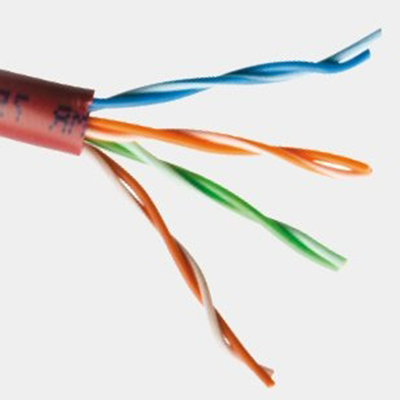
As we’re all too aware, sometimes the installation of connectivity services can have a long lead time – if this is delayed by construction, you can often be faced with a significant wait until services can be provisioned.
So, to combat this, there are several options available, let’s weigh up the pros and cons of a few differing technologies. We’ll exclude traditional leased fibre (FTTP) from this discussion as if you could have utilised it, you likely would have!
4G Data
Pros:
- Very Fast to deploy <1 day.
- Speeds of up to 30Mbps in good signal areas
- Competitive pricing for Bandwidth
- Cost effective hardware
Cons:
- Operation depends entirely on reception
- Saturation of network heavily impacts performance
- Not capable of sustained high speeds
- Can be easily interrupted and prone to external influence
4G options have come on leaps and bounds in the past 2-3 years. Utilising multiple bonded SIMs from diverse carriers and a load balancing router device, reasonable speeds of 30Mbps are achievable – as long as there is good signal.
This is where 4G has it’s major downfall – signal and saturation. Some areas of a property may have no signal whatsoever – even outdoor areas may be in a blackspot with no signal strength at all. Even in areas with a full signal strength, the network can be fully saturated, meaning that you receive speeds of less than 200Kbps. Unfortunately it’s often difficult to ascertain this in advance.
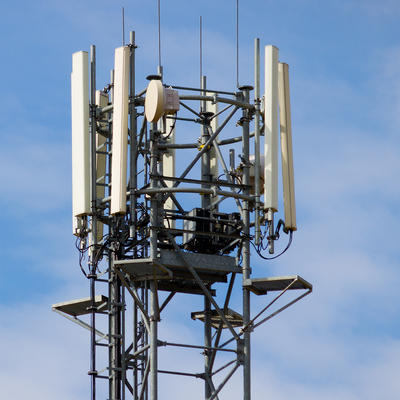
Areas such as the City of London suffer with saturation, especially around transport hubs, rendering 4G ultimately futile during busy periods.
Costs vary greatly, but some vendors will offer a sub £100 a month option for 20Mbps of bandwidth on a un-metered tariff. If sourcing from a Mobile phone provider, expect similar costs to a standard mobile phone contract with 60GB of data coming in at around £60 a month.
Noteworthy Vendors: Relish Broadband (Central London Only). Pepwave (hardware bonded routers), Vodafone 4G hotspots.
P2P Wireless Radio / Wibre / Microwave
Pros:
- Fast deployment <5 days
- Speeds of up to 1Gbps depending on location
- Fully resilient options available with multiple antennae
- Due to installation on roof tops, can avoid potential Civils issues with ground level intakes
Cons:
- Operation can be disrupted by extreme weather
- Requires Line of Sight to operate
- Each link is limited to under 5km of distance
- Can be disrupted by construction across city skyline
P2P Links via radio have been with us for some time, however the technology is ever-advancing. Shared links with 25Mbps of bandwidth are quick to deploy, as long as you have line of sight and dedicated circuits of 1Gbps are also on the market, although these often require more specialised installation and dedicated ‘hops’ to the suppliers core network.
Line of sight is the biggest drawback here, as taller properties have clear line of sight (LoS), whereas smaller 4-5 storey properties in central London may well struggle.
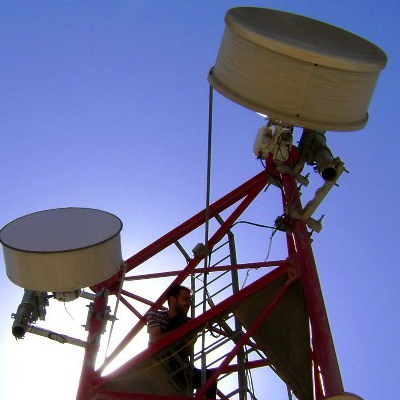
Taller properties have their own issues though, as most of them will have window cleaning apparatus (especially on glass and steel constructions) which, when in operation, will move around the top of the property. At a certain point, this will block the LoS and take down your link. You can avoid this by having dual antenna, however, this increases costs significantly.
If you’re struggling with fibre intakes due to local authority civil works (which can take many months with inner London councils), this is a refreshing option as going upwards to a satellite farm on the roof of a property is often easier than getting a street dug up for a new fibre intake.
Price wise, 100Mbps should run you at between £500 – £700 per month with no installation cost on a 3 year deal.
Noteworthy Vendors: Urban Wimax, Optimity, Fluidmesh.
EFM (Ethernet First Mile)
Pros:
- Speeds of up to 20Mbps.
- Competitive pricing
- Guaranteed up/down speeds on symmetrical service
- Widely available.
Cons:
- Speeds are limited
- reasonably slow to deploy (45 days)
- If distribution is saturated, installation will long winded
EFM is a circuit of bonded copper pairs, offering reasonable download speeds for a competitive price.
The availability of this service relies on the distance to the exchange – distances of over a mile would severely degrade the service, so distance is key and the driver for availability.
As this option doesn’t utilise existing hardware in most cases, installation can be slow, however it’s worth investigating as there may be adequate capacity for a quick install.
As EFM is a symmetrical service, speeds are guaranteed and subject to an SLA – meaning that this may be a good option for small bandwidth requirements that run business critical applications.
Pricing starts at around £125 per month for a EFM service.
Noteworthy Vendors: Most major carriers will offer this option, depending on location.
FTTC (Fibre to the Cabinet)
Pros:
- Speeds of up to 100Mbps.
- Very Competitive pricing
- reasonably fast to deploy (15-20 days)
- Widely available.
Cons:
- No Guaranteed up/down speeds
- Speed heavily impacted by usage at cabinet
- Speed impacted by distance from cabinet
FTTC (sometimes referred to as ‘Superfast Broadband’) is a fibre network to the local distribution cabinet, then a traditional copper line to your premises. Speed is highly dependant on distance from the cabinet and other customers utilising the cabinet for FTTC services.

Whilst there is unlikely to be an SLA on the line or a guaranteed up/down speed, it is likely to give fair performance in most locations. The average speed is 35Mbps down and 22Mbps up in the UK across FTTC. Because of this, there is a risk of outage or degradation in speed, therefore its recommended as an internet breakout or non-critical service line.
Due to the utilisation of existing equipment in most locations, installation is usual fast and doesn’t require a unique wayleave in most cases.
Costs start at £45-£50 a month for FTTC and is available across 90% of the UK by 2020.
Noteworthy Vendors: Most major carriers will offer this option, depending on location.
Conclusion
In conclusion, there are plenty of options available, varying in speed, deployment and stability. What one options gains in one field, it normally loses in the others.
For ultimate speed of deployment, 4G can be done in a matter of hours, but with that comes uncertainty and unreliability.
For stability, EFM is the most resilient, but takes almost as long to install as dedicated FTTP.
It really does depend on your user case and budget, but we heartily recommend contacting us if you’d like to investigate any of these options for your fast tracked IT deployment.